Story kit
Typed lines with name plates, faces that react, and choices that set flags.
Open in the basketTyped lines with name plates that never cover the speaker. An add-on for any game.
What it does
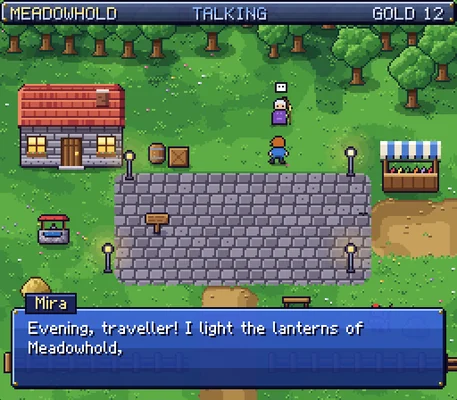
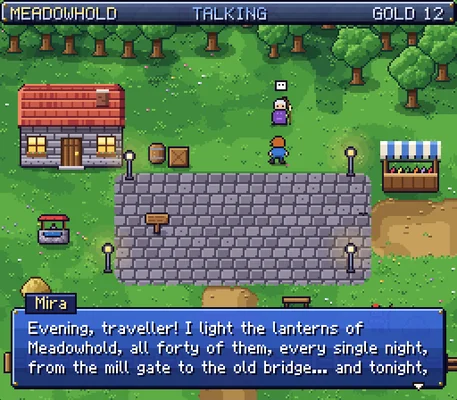
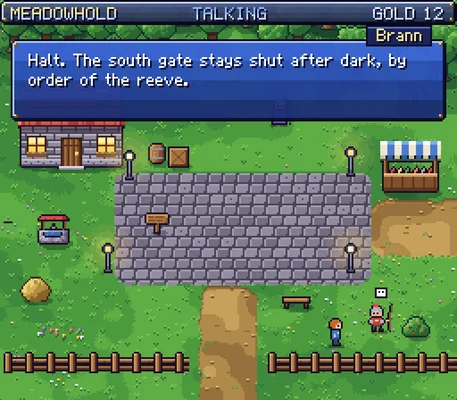
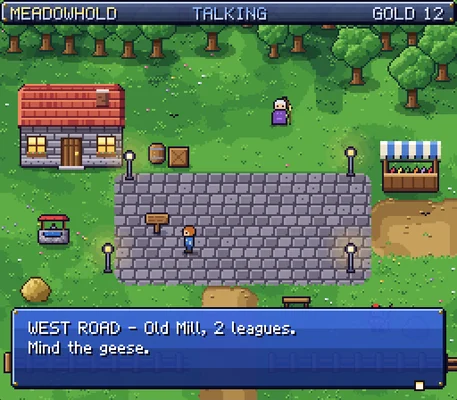
Story text in a framed box at the bottom (or top) of the screen: each line types out letter by letter with small pauses at punctuation, a name tag sits on the speaker's side, a blinking arrow waits for Z / Enter / tap.
Moments
 Play from here
 Play from here
 Play from here
 Play from here
Take it home
dialogue-box.js) and its README.# Add Typewriter dialogue box to my game Add the game element below to MY existing game, which you have not seen. It is a finished module file given with this prompt: - `dialogue-box.js` (one global, `GameDNA_DialogueBox`), API reference `dialogue-box.README.md` README example names are placeholders. ## Where it goes in my game (my choice; follow it exactly) - **Typewriter dialogue box:** Use the dialogue box for exactly: everything the game already shows as text in a message box: talking to characters, reading signs, item and chest messages. Only text the player reads and dismisses (talk, signs, item/chest messages, story beats); leave self-clearing captions, combat logs, banners and the game's own result overlays as they are. ## Shared premises 1. **Include each module file verbatim; never edit it.** Load it with its own `<script src>` before the game's script, or paste it unchanged into its own `<script>` tag. If a module seems to need a change, adapt my game around it and tell me. 2. **Resolution:** keep my game's native resolution and integer scaling as they are. Call module draw functions on my 2D context inside the same transform as my sprites (one module pixel = one game pixel), and keep my game's own image-smoothing setting (off for pixel art, on for smooth or HD games; never switch it). 3. **Time:** drive every module from one fixed 60 Hz step (1000 / 60 ms). If my loop uses variable delta time, accumulate it and run whole steps (at most 250 ms per frame). 4. **Coordinates:** native screen pixels (world minus camera) unless a section says tiles. 5. **Art and names:** anything new you draw or name is original (no real game, character, place or brand names); English UI text; do not restyle my game. 6. **Hook, don't replace:** add calls or change bodies; never delete or rename a function.Open the whole prompt
Works well with
Typed lines with name plates, faces that react, and choices that set flags.
Open in the basket