RPG growth kit
Spend gold in a shop, level up after the fight, keep it all in save slots.
Open in the basketA shop with item grids, prices and stat comparisons. An add-on for any game.
What it does
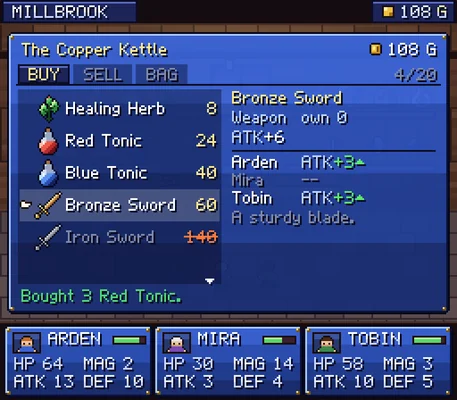
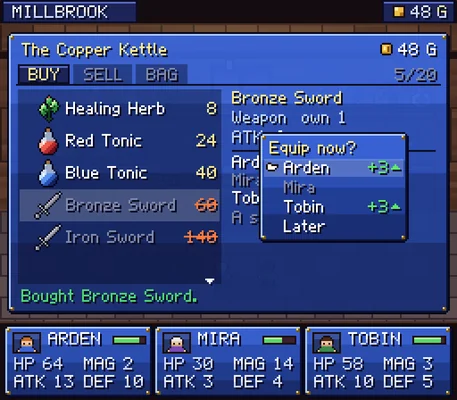
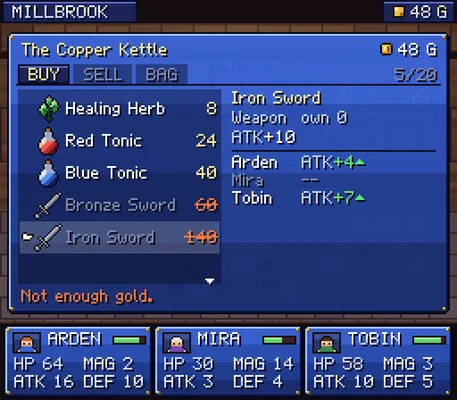
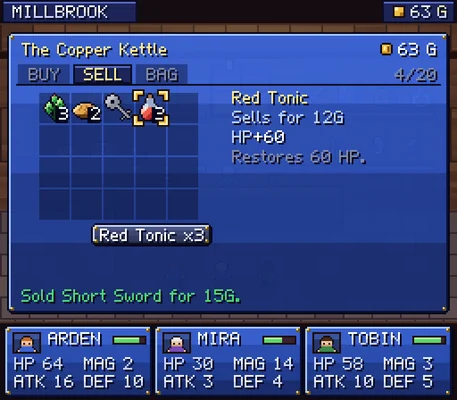
A modal shop window: buy and sell lists with icons, prices and an amount picker, a bag grid with stacks, a max stack and a capacity, tooltips, and green up / red down arrows comparing gear against what each party member wears.
Moments
 Play from here
 Play from here
 Play from here
 Play from here
Take it home
shop-inventory.js) and its README.# Add Shop & inventory grid to my game Add the game element below to MY existing game, which you have not seen. It is a finished module file given with this prompt: - `shop-inventory.js` (one global, `GameDNA_ShopInventory`), API reference `shop-inventory.README.md` README example names are placeholders. ## Where it goes in my game (my choice; follow it exactly) - **Shop & inventory grid:** The shop opens exactly at: a merchant the hero talks to. Do not open it anywhere else. ## Shared premises 1. **Include each module file verbatim; never edit it.** Load it with its own `<script src>` before the game's script, or paste it unchanged into its own `<script>` tag. If a module seems to need a change, adapt my game around it and tell me. 2. **Resolution:** keep my game's native resolution and integer scaling as they are. Call module draw functions on my 2D context inside the same transform as my sprites (one module pixel = one game pixel), and keep my game's own image-smoothing setting (off for pixel art, on for smooth or HD games; never switch it). 3. **Time:** drive every module from one fixed 60 Hz step (1000 / 60 ms). If my loop uses variable delta time, accumulate it and run whole steps (at most 250 ms per frame). 4. **Coordinates:** native screen pixels (world minus camera) unless a section says tiles. 5. **Art and names:** anything new you draw or name is original (no real game, character, place or brand names); English UI text; do not restyle my game. 6. **Hook, don't replace:** add calls or change bodies; never delete or rename a function.Open the whole prompt
Works well with
Spend gold in a shop, level up after the fight, keep it all in save slots.
Open in the basket