NPC generator
Seeded townsfolk who wander, turn to face you and talk in a dialogue panel with their own pixel portrait. An add-on for any game.
What it does
Seeded townsfolk built from parts (age, body type, skin, hair style and colour, clothes, hats, glasses or beards, satchels and scarves), hand-pixelled in code in one style with a 4-frame walk in four directions.
Made fortop-down RPGs, adventures and life sims with towns, markets and villagesany 16-bit style game that needs many background people that do not all look alikegames with procedural towns that need people to match their seed
Moments
Four moments from the demo
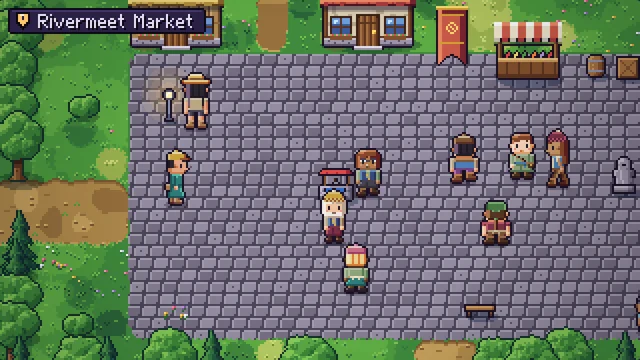 Play from here
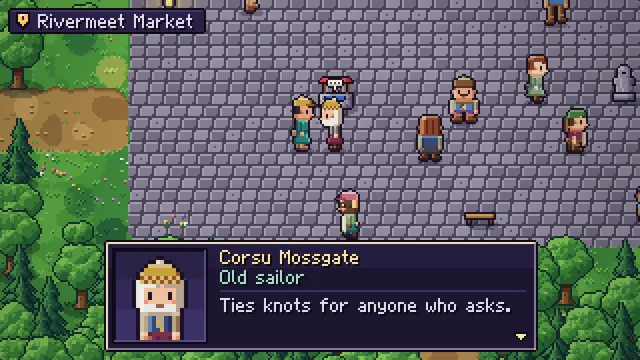 Play from here
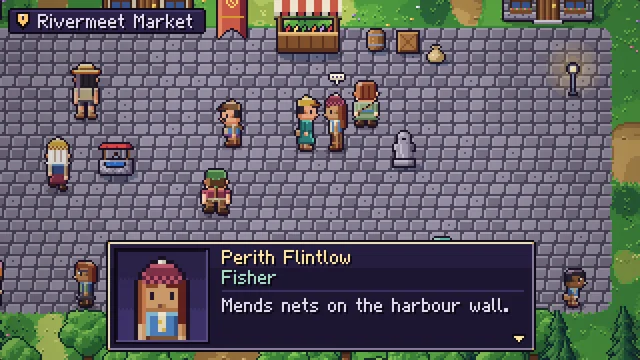 Play from here
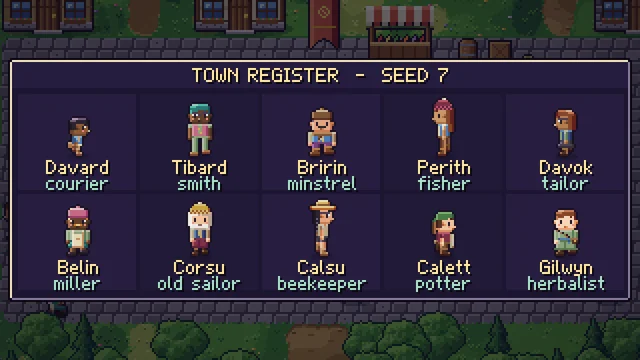 Play from here
Take it home
Hand it to your agent
- Copy the prompt. It is written for a game your agent has never seen.
- Give it the module (
npc-generator.js) and its README. - Play your game. The prompt ends with checks your agent can run.
# Add NPC generator to my game

Add the game element below to MY existing game, which you have not seen. It is a finished module file given with this prompt:

- `npc-generator.js` (one global, `GameDNA_NpcGen`), API reference `npc-generator.README.md`

README example names are placeholders.

## Shared premises

1. **Include each module file verbatim; never edit it.** Load it with its own `<script src>` before the game's script, or paste it unchanged into its own `<script>` tag. If a module seems to need a change, adapt my game around it and tell me.
2. **Resolution:** keep my game's native resolution and integer scaling as they are. Call module draw functions on my 2D context inside the same transform as my sprites (one module pixel = one game pixel), and keep my game's own image-smoothing setting (off for pixel art, on for smooth or HD games; never switch it).
3. **Time:** drive every module from one fixed 60 Hz step (1000 / 60 ms). If my loop uses variable delta time, accumulate it and run whole steps (at most 250 ms per frame).
4. **Coordinates:** native screen pixels (world minus camera) unless a section says tiles.
5. **Art and names:** anything new you draw or name is original (no real game, character, place or brand names); English UI text; do not restyle my game.
6. **Hook, don't replace:** add calls or change bodies; never delete or rename a function.
Open the whole prompt
Works well with
Combine it
Also pairs well with
Active-time gauge battleGauges fill in real time, so every turn feels urgent.
Motion-input special movesSpecial moves from quarter circles, charges and full circles, with an input display.
Bullet-pattern emitterEnemies cast fans, rings, spirals and flowers of bullets, always with a gap to slip through.
Conditional tactic rulesUnits that act by your rules, and say which rule fired.
Fog of warHide what your units cannot see.
Level-select path revealA world map whose path draws itself to the next level.