Grappling hook & swing
A hook you fire at rings and rock, swing from with real momentum, and wrap around corners. An add-on for any game.
What it does
Fire a hook at iron rings (aim assist) or any rock surface, hang on a rope of fixed length and swing like a pendulum, pump with left / right, reel in and out, jump off or let go keeping the swing's momentum.
Made forside-scrolling platformermetroidvaniaaction platformerprecision platformerside-view adventure
Moments
Four moments from the demo
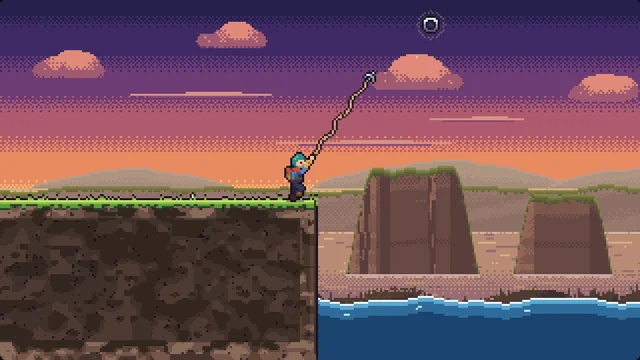 Play from here
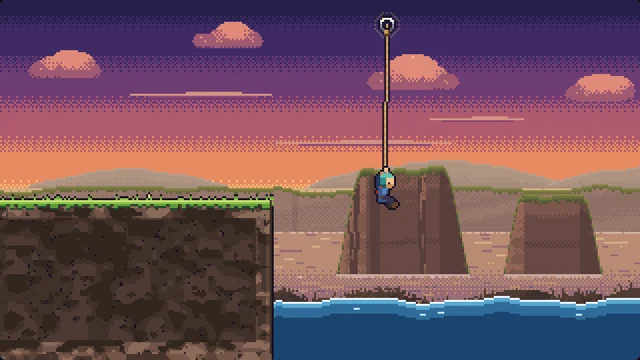 Play from here
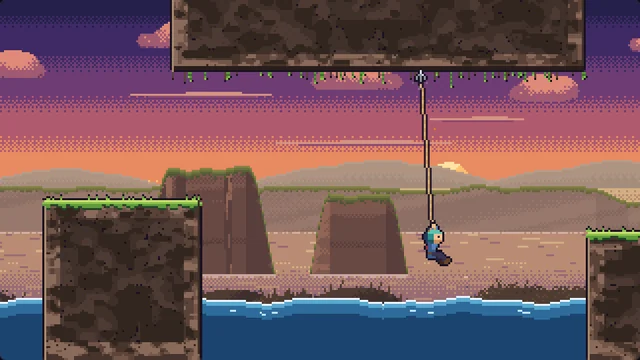 Play from here
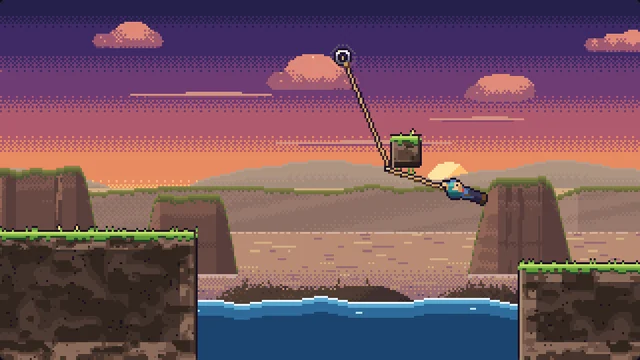 Play from here
Take it home
Hand it to your agent
- Copy the prompt. It is written for a game your agent has never seen.
- Give it the module (
grapple-swing.js) and its README. - Play your game. The prompt ends with checks your agent can run.
# Add Grappling hook & swing to my game

Add the game element below to MY existing game, which you have not seen. It is a finished module file given with this prompt:

- `grapple-swing.js` (one global, `GameDNA_Grapple`), API reference `grapple-swing.README.md`

README example names are placeholders.

## Shared premises

1. **Include each module file verbatim; never edit it.** Load it with its own `<script src>` before the game's script, or paste it unchanged into its own `<script>` tag. If a module seems to need a change, adapt my game around it and tell me.
2. **Resolution:** keep my game's native resolution and integer scaling as they are. Call module draw functions on my 2D context inside the same transform as my sprites (one module pixel = one game pixel), and keep my game's own image-smoothing setting (off for pixel art, on for smooth or HD games; never switch it).
3. **Time:** drive every module from one fixed 60 Hz step (1000 / 60 ms). If my loop uses variable delta time, accumulate it and run whole steps (at most 250 ms per frame).
4. **Coordinates:** native screen pixels (world minus camera) unless a section says tiles.
5. **Art and names:** anything new you draw or name is original (no real game, character, place or brand names); English UI text; do not restyle my game.
6. **Hook, don't replace:** add calls or change bodies; never delete or rename a function.
Open the whole prompt
Works well with
Combine it
Also pairs well with
Active-time gauge battleGauges fill in real time, so every turn feels urgent.
Platformer movement feelJumps that forgive late presses and land where you meant.
Motion-input special movesSpecial moves from quarter circles, charges and full circles, with an input display.
Hit sparks & spell burstsSlashes, bursts and shockwaves where hits land.
Shatter battle transitionThe screen shatters as a battle begins.
Hit-stop, shake & flashA frozen beat, a shake and a flash on big hits.