Platformer movement feel
Jumps that forgive late presses and land where you meant. A complete starter game you can extend.
What it does
Side-view hero movement and tile collision that feels good: acceleration curves on the ground and in the air, variable jump height, coyote time, jump buffering, apex hang, terminal fall speed.
Made forside-view platformersaction platformers with a dashmetroidvania-style explorationprecision / speedrun platformersside-scrolling action games with jumping
Tested: 6/6 runs on unseen games passed · visual review 7.8 / 8
Moments
Four moments from the demo
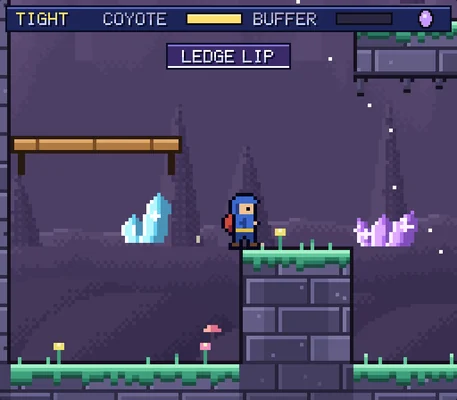 Play from here
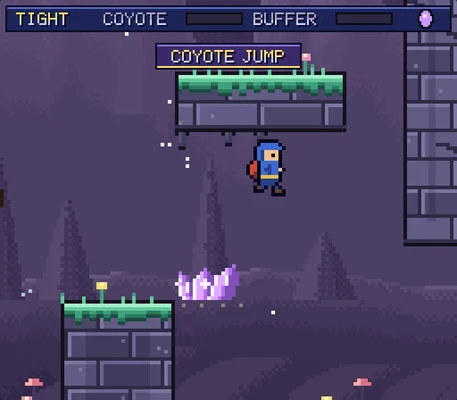 Play from here
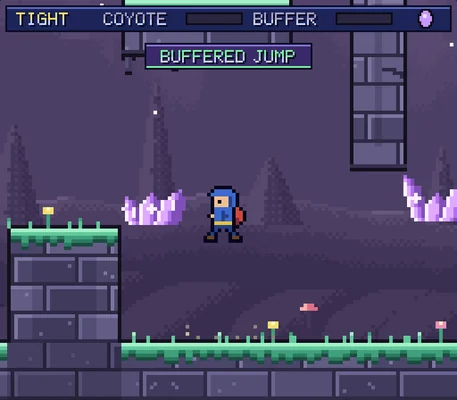 Play from here
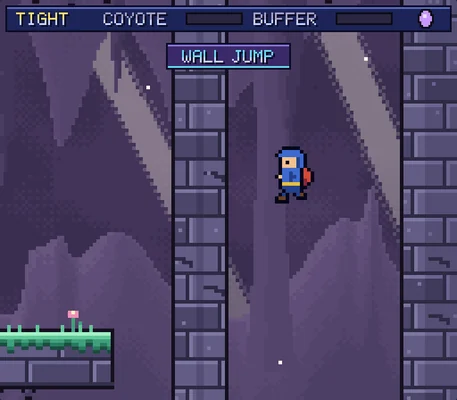 Play from here
Take it home
Hand it to your agent
- Copy the prompt. It is written for a game your agent has never seen.
- Give it the module (
platformer-feel.js) and its README. - Play your game. The prompt ends with checks your agent can run.
# Add Platformer movement feel to my game

Add the game element below to MY existing game, which you have not seen. It is a finished module file given with this prompt:

- `platformer-feel.js` (one global, `GameDNA_Platformer`), API reference `platformer-feel.README.md`

README example names are placeholders.

## Shared premises

1. **Include each module file verbatim; never edit it.** Load it with its own `<script src>` before the game's script, or paste it unchanged into its own `<script>` tag. If a module seems to need a change, adapt my game around it and tell me.
2. **Resolution:** keep my game's native resolution and integer scaling as they are. Call module draw functions on my 2D context inside the same transform as my sprites (one module pixel = one game pixel), and keep my game's own image-smoothing setting (off for pixel art, on for smooth or HD games; never switch it).
3. **Time:** drive every module from one fixed 60 Hz step (1000 / 60 ms). If my loop uses variable delta time, accumulate it and run whole steps (at most 250 ms per frame).
4. **Coordinates:** native screen pixels (world minus camera) unless a section says tiles.
5. **Art and names:** anything new you draw or name is original (no real game, character, place or brand names); English UI text; do not restyle my game.
6. **Hook, don't replace:** add calls or change bodies; never delete or rename a function.
Open the whole prompt
Works well with
Combine it
Also pairs well with
Modern damage numbersHits arc out, crits pop, combos roll into one total.
Bouncing damage numbersDamage that pops above the target and bounces.
Hit sparks & spell burstsSlashes, bursts and shockwaves where hits land.
Dissolve-out defeatDefeated enemies crumble away instead of vanishing.
Squash, stretch & anticipationCharacters that crouch, stretch and squash with every move.
Modern particle systemSparks that bounce, smoke that drifts and thousands of glowing motes.