Skip to content
Game DNA Play a demo

Art-direction lock

Generated art that all looks like one artist made it. An add-on for any game.

Live demoPlay with it: the controls sit beside or under the game.

✦ AI art This element ships a sample pack of pictures made with an AI image generator; the demo uses them. About the art

What it does

Generate one style-reference sheet for the game (a character, a prop, a floor patch and an item), lock it, and pass it as a reference image to every later generation, so all generated bitmaps share one light, outline.

Made fortop-down adventure / action RPGside-scrolling platformertactics / strategy mapturn-based RPG battlefarming / life simany game moving from code-drawn to painted HD art

Tested: 5/6 runs on unseen games passed · visual review 8

Moments

Four moments from the demo

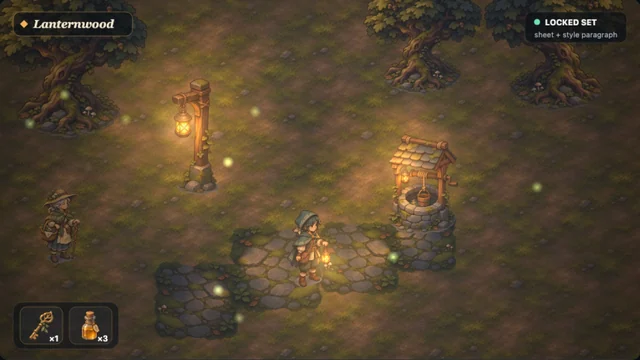
The village in one locked style: seamless ground, warm lamp light, no fringes.Play from here
The village in one locked style: seamless ground, warm lamp light, no fringes.
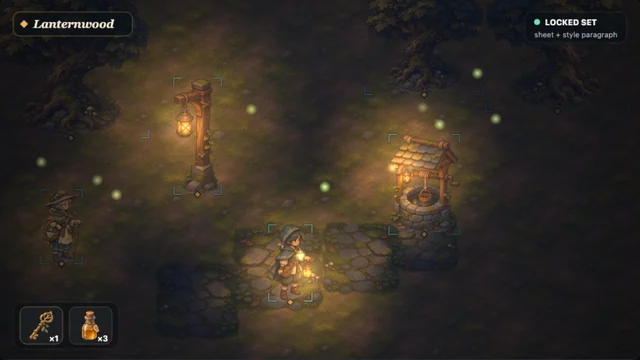
Night, anchors on: every foot cross sits on its sprite's ground line.Play from here
Night, anchors on: every foot cross sits on its sprite's ground line.
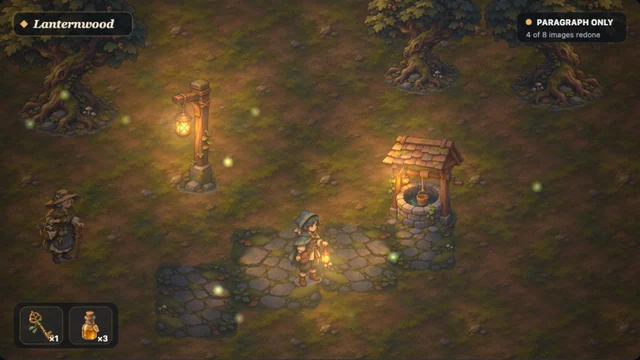
Paragraph only: four of eight images made without the reference sheet.Play from here
Paragraph only: four of eight images made without the reference sheet.
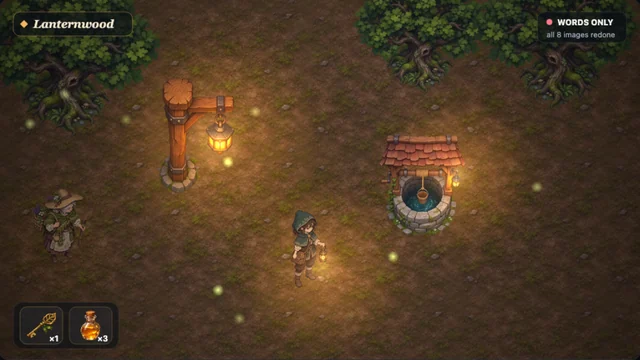
Words only: all eight images from one-line prompts, and the set breaks.Play from here
Words only: all eight images from one-line prompts, and the set breaks.

Take it home

Hand it to your agent

  1. Copy the prompt. It is written for a game your agent has never seen.
  2. Give it the module (art-direction-lock.js) and its README.
  3. Play your game. The prompt ends with checks your agent can run.
ModuleREADME
prompt.md · 70 lines
# Add Art-direction lock to my game

Add the game element below to MY existing game, which you have not seen. It is a finished module file given with this prompt:

- `art-direction-lock.js` (one global, `GameDNA_Assets`), API reference `art-direction-lock.README.md`

README example names are placeholders.

## Shared premises

1. **Include each module file verbatim; never edit it.** Load it with its own `<script src>` before the game's script, or paste it unchanged into its own `<script>` tag. If a module seems to need a change, adapt my game around it and tell me.
2. **Resolution:** keep my game's native resolution and integer scaling as they are. Call module draw functions on my 2D context inside the same transform as my sprites (one module pixel = one game pixel), and keep my game's own image-smoothing setting (off for pixel art, on for smooth or HD games; never switch it).
3. **Time:** drive every module from one fixed 60 Hz step (1000 / 60 ms). If my loop uses variable delta time, accumulate it and run whole steps (at most 250 ms per frame).
4. **Coordinates:** native screen pixels (world minus camera) unless a section says tiles.
5. **Art and names:** anything new you draw or name is original (no real game, character, place or brand names); English UI text; do not restyle my game.
6. **Hook, don't replace:** add calls or change bodies; never delete or rename a function.
Open the whole prompt