Pixel bitmap font
Crisp bitmap text that types out. An add-on for any game.
What it does
Every letter on a low-res canvas drawn from an original 1-bit bitmap font at whole pixels, so text is as crisp as the sprites at any scale.
Made forturn-based RPG battleplatformeraction RPGtactics / strategy RPGadventure / dialogue scenesroguelikearcade (score, lives, timers)
Moments
Four moments from the demo
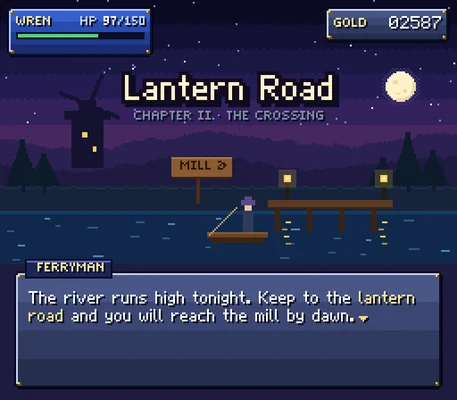 Play from here
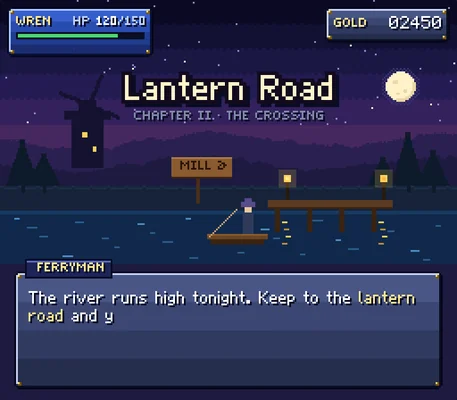 Play from here
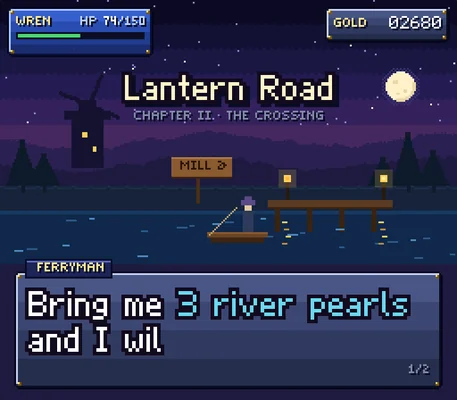 Play from here
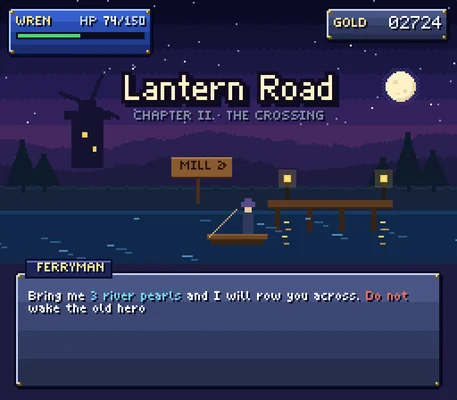 Play from here
Take it home
Hand it to your agent
- Copy the prompt. It is written for a game your agent has never seen.
- Give it the module (
pixel-font.js) and its README. - Play your game. The prompt ends with checks your agent can run.
# Add Pixel bitmap font to my game

Add the game element below to MY existing game, which you have not seen. It is a finished module file given with this prompt:

- `pixel-font.js` (one global, `GameDNA_PixelFont`), API reference `pixel-font.README.md`

README example names are placeholders.

## Shared premises

1. **Include each module file verbatim; never edit it.** Load it with its own `<script src>` before the game's script, or paste it unchanged into its own `<script>` tag. If a module seems to need a change, adapt my game around it and tell me.
2. **Resolution:** keep my game's native resolution and integer scaling as they are. Call module draw functions on my 2D context inside the same transform as my sprites (one module pixel = one game pixel), and keep my game's own image-smoothing setting (off for pixel art, on for smooth or HD games; never switch it).
3. **Time:** drive every module from one fixed 60 Hz step (1000 / 60 ms). If my loop uses variable delta time, accumulate it and run whole steps (at most 250 ms per frame).
4. **Coordinates:** native screen pixels (world minus camera) unless a section says tiles.
5. **Art and names:** anything new you draw or name is original (no real game, character, place or brand names); English UI text; do not restyle my game.
6. **Hook, don't replace:** add calls or change bodies; never delete or rename a function.
Open the whole prompt
Works well with
Combine it
Also pairs well with
Weather & ambient particlesRain, snow, leaves and fireflies in layers.
Branching run mapA branching route of fights, shops and rests up to a boss.
Multi-layer parallax backdropA layered backdrop that scrolls with depth.
Active-time gauge battleGauges fill in real time, so every turn feels urgent.
Four-move menu battle with type matchupsPick one of four moves; type matchups decide the damage.
Combat forecast windowSee damage, hit chance and counters before you commit.