Arcade kart racer (3D)
A 3D kart race with drifts that charge boosts, jumps, rivals and a two-race cup. A complete starter game you can extend.
What it does
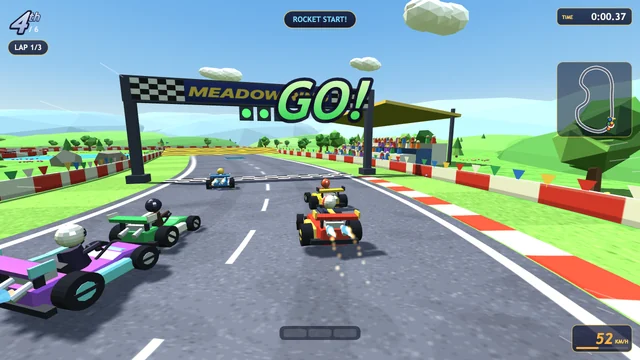
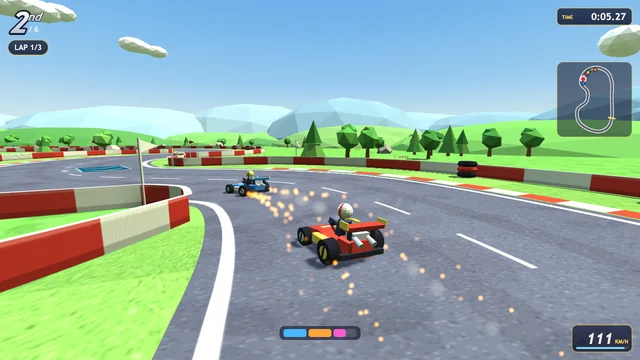
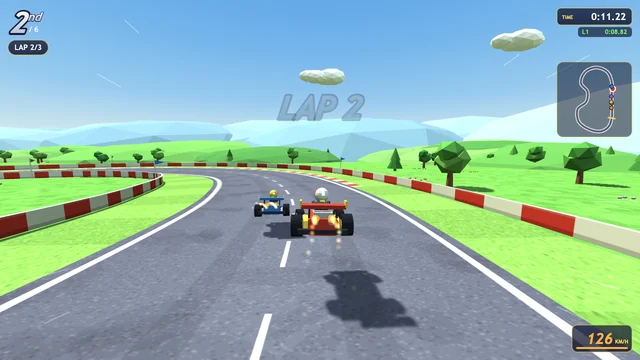
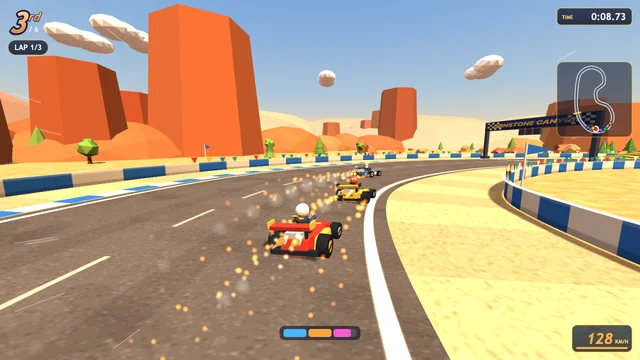
A low-poly 3D kart race: a track built from a closed spline (road, kerbs, barriers, ramps, boost pads, start gantry with countdown lamps), karts with drivers auto-scaled so the wheels sit on the ground, arcade physics with grip.
Made forarcade kart and party racersa racing mini-game inside a larger game (festival, hub world)time trials and ghost-free lap challengesa cup of short tracks with pointstoy-car or creature racers that need drift-boost handling
Tested: 14/14 runs on unseen games passed · visual review 7.6
Moments
Four moments from the demo
Take it home
Hand it to your agent
- Copy the prompt. It is written for a game your agent has never seen.
- Give it the module (
kart-racer-3d.js) and its README. - Play your game. The prompt ends with checks your agent can run.
# Add Arcade kart racer (3D) to my game

Add the game element below to MY existing game, which you have not seen. It is a finished module file given with this prompt:

- `kart-racer-3d.js` (one global, `GameDNA_KartRacer3D`), API reference `kart-racer-3d.README.md`

README example names are placeholders.

## Shared premises

1. **Include each module file verbatim; never edit it.** Load it with its own `<script src>` before the game's script, or paste it unchanged into its own `<script>` tag. If a module seems to need a change, adapt my game around it and tell me.
2. **Resolution:** keep my game's native resolution and integer scaling as they are. Call module draw functions on my 2D context inside the same transform as my sprites (one module pixel = one game pixel), and keep my game's own image-smoothing setting (off for pixel art, on for smooth or HD games; never switch it).
3. **Time:** drive every module from one fixed 60 Hz step (1000 / 60 ms). If my loop uses variable delta time, accumulate it and run whole steps (at most 250 ms per frame).
4. **Coordinates:** native screen pixels (world minus camera) unless a section says tiles.
5. **Art and names:** anything new you draw or name is original (no real game, character, place or brand names); English UI text; do not restyle my game.
6. **Hook, don't replace:** add calls or change bodies; never delete or rename a function.
Open the whole prompt
Works well with
Combine it
Also pairs well with
Conditional tactic rulesUnits that act by your rules, and say which rule fired.
Bevelled window + pointer cursorClassic framed menus with a bobbing pointer.
Turn-order barA strip of portraits showing who acts next.
Draining HP barHP bars that drop at once, then drain a pale loss segment so every hit reads.
Modern damage numbersHits arc out, crits pop, combos roll into one total.
Toasts & unlock pop-upsItem, quest and achievement pop-ups that stack and merge without pausing.